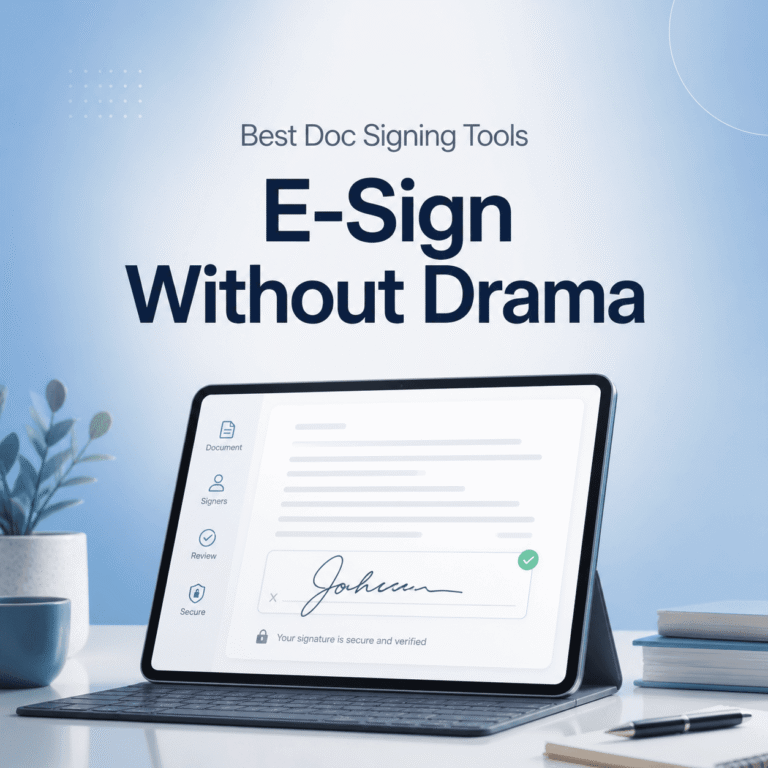
A good proposal template turns ‘send me a quote’ into a signed deal.
Service client proposals only. Not grant proposals, research proposals, government bids/RFP responses, or marriage proposals.
Most “email quotes” get ignored because they’re just a number floating in space. No context, no options, no clear next step, so the client does what humans do when unsure: they stall.
This guide gives you a 10-section proposal structure you can reuse, a copy-paste fill-in-the-blank template, examples for common service businesses, and a simple way to send it so clients sign faster.
Quick answer: what a winning proposal template includes
- Cover page: Makes it instantly clear what this is, who it’s for, and the outcome you’re buying.
- The client’s goal (in their words): Shows you listened and anchors everything to what they care about.
- Your approach: Explains how you’ll get them there, plus who’s doing what.
- Scope and deliverables: Turns “services” into specific outputs, with boundaries.
- Timeline and milestones: Sets expectations, dependencies, and decision points.
- Pricing table: Gives clear options so they choose a level, not whether to hire you.
- Why you: proof and results: Builds trust with tight, relevant proof.
- Key terms in plain English: Clarifies assumptions and responsibilities so nothing gets weird later.
- Next steps: Removes friction and gives a decision path with a date.
- Acceptance and sign-off: Lets them approve, pay, and book kickoff without back-and-forth.
To streamline the process of gathering necessary information from your clients before drafting the proposal, consider using a client intake form template. This can help ensure that all relevant details are captured efficiently.
Copy the fill-in-the-blank template below and adapt it to your business.
Some links here may earn ToolPickGuide a commission. It never changes our verdict. Why we disclose: the FTC’s endorsement guidance.
What a business proposal is (and when to send one)
A business (service) proposal is your pitch after the discovery call and before the deal. It states the client’s goal, your plan, the price, and the timeline, in a way that makes the decision feel safe.
Best timing: send it after you’ve confirmed fit and scope on a call, and before you start work. It’s also the right move when an inbound lead says “send me a quote”, because the proposal gives the quote a brain and a spine.
Here’s the clean separation:
- Proposal: pitch before yes.
- Contract: binding terms after yes.
- Business plan: for lenders/investors, not clients. See SBA’s guide to a business plan.
A proposal can also function as an offer in contract law, depending on how you write and present it. Cornell’s plain-English idea is: an offer is made in a way that would lead a reasonable person to expect a binding contract from its acceptance.
Set expectations like this: proposals sell clarity and reduce risk; contracts handle legal protection. In many service businesses, you send proposal first, contract second, or you use proposal + acceptance as part of your agreement depending on your process.
This is general information, not legal advice.
The 10 sections of a proposal template that wins clients
The principle is simple: make saying yes easy. Clarity, specificity, options, and a frictionless next step.
Think of a proposal with one price like a menu with one dish. The client can only say yes or leave, and leaving is the path of least resistance.
The sections below form a reusable proposal template for most service businesses.
To make this easier to implement, add simple visuals to break up text. A screenshot of your pricing table, a simple timeline graphic, or a one-page “deliverables” graphic can do a lot of work for you.

1. Cover page
Your cover page is not decoration. It’s the “yes, this is for me” moment.
Summarize the client’s goal in their words and include one or two measurable outcomes. Then restate what you’re recommending and the expected result, in plain language.
Keep it skimmable: three to six sentences. No jargon. No origin story.
Include the basics so it feels official and easy to forward:
- Project name (example: “Website Redesign Proposal for Acme Corp”)
- [Client Name] + main contact
- [Your Business Name] + contact info
- Date
- Optional: version number (helpful when scope changes)
Mistake to avoid: leaving out contact details or version control. If they forward it internally and your name is nowhere, you’re making it harder to buy.
2. The client’s goal (in their words)
This is where you demonstrate your attentiveness during the discovery call. Use their language, not yours.
List the top three problems or goals you discovered, as bullets. Then add a short snapshot of what’s happening today, what’s at stake, and what they’ve already tried.
Finally, show the cost of inaction without getting dramatic. The point is clarity, not fear.
Example framing:
- What’s happening now
- What “better” looks like
- What it costs to wait (time, missed revenue, stress, internal churn)
Mistake to avoid: generic goals like “improve online presence.” If the goal could be pasted into any proposal, it won’t feel personal.
3. Your approach
This is the plan, at the “smart friend” level. Not vague, not overly technical.
Describe deliverables and responsibilities, and separate yours from theirs. Use testable language, meaning the client can point at the page and say “yes, I got that.”
Also, include boundaries. Scope creep isn’t a personality flaw, it’s what happens when a proposal is blurry.
Good things to define here:
- Platforms included (and not included)
- Pages, campaigns, or assets included
- Revision limits
- Meeting cadence
- Feedback turnaround expectations
A well-structured approach can be likened to a project charter, which serves as a roadmap for successful project execution.
Example (simple): “We’ll audit your current site, propose a new homepage structure, design two concepts, implement the approved design, and QA before launch.”
Mistake to avoid: being too vague (“we’ll improve your brand”) or too technical (“we’ll refactor your component library”) for the buyer reading it.
4. Scope and deliverables
Yes, “scope and deliverables” sounds similar to “your approach.” Here’s the difference:
- Approach explains how you’ll work.
- Scope/deliverables lists exactly what they get.
Outline phases like kickoff → research → execution → review → launch. Give a realistic timeline with dependencies, like client feedback, access, assets, approvals.
Also include your communication rhythm. People buy calm as much as they buy the work.
Common rhythm language:
- Weekly email update
- One check-in call per week or per milestone
- Typical turnaround time for reviews
- Where communication happens (email, Slack, portal)
Mistake to avoid: leaving deliverables implied. “Full service” is not a deliverable.
5. Timeline and milestones
Convert the project into concrete checkpoints. Clients relax when they can see the road.
Include milestones that match your phases and note dependencies. If you’re waiting on logins, content, or approvals, say it clearly.
Also: don’t use “ASAP.” “ASAP” is a guarantee you can’t keep, because it depends on other humans.
Example structure:
- Week 1: kickoff + access + baseline
- Week 2: research + first draft
- Week 3: review + revisions
- Week 4: launch + handoff
Mistake to avoid: no deadlines at all. A proposal without time is a project that never starts.
6. Pricing table
This is where most “email quotes” fail. They give one number, with no explanation, so the buyer has to invent the reasoning. That’s like asking them to write your sales story for you.
Present two to three package options (Good/Better/Best) or tiers by scope. Keep the differences obvious, and keep the quality consistent. You’re changing volume or breadth, not doing “worse work” on the cheap plan.
Show totals clearly, specify billing model (one-time, monthly retainer, milestone-based), and explain what drives cost in plain language (time, complexity, volume).
Include:
- Payment schedule
- Light-touch late fee policy
- What happens if scope changes (change request process)
Mistake to avoid: hiding the number on the last page like it’s a confession. Put pricing where it’s easy to find, and anchor it to outcomes and deliverables.
You can build this table in any decent doc tool, but proposal tools like HoneyBook, Dubsado, and Bonsai make acceptance easier. These platforms often allow for online acceptance of proposals which can streamline the process significantly. However, if you’re looking for a more comprehensive solution that includes features like e-signatures, it’s worth exploring some of the best doc signing tools available.
7. Why you: proof and results
Keep this tight. The goal is trust, not a biography.
Add one to three short case snippets in this format:
- Problem
- Work done
- Result (if you have it)
Then add testimonials that match the client’s industry or goal. If you have a mini portfolio, link it or add a couple screenshots.
If you don’t have testimonials yet, don’t panic. Use “relevant experience” bullets: similar projects, years in the niche, specific systems you use, or outcomes you’ve helped with, stated honestly.
Mistake to avoid: overloading this section. Proof should feel like seasoning, not the whole meal.
8. Key terms in plain English
This section prevents awkward surprises. It’s your “here’s how this goes smoothly” page.
List assumptions that affect timeline or results:
- Access to accounts
- Approval turnaround
- Brand assets and content availability
- Technical constraints (if relevant)
Define client responsibilities:
- Single point of contact
- Feedback deadlines
- Providing content/assets
- Attending key meetings
State how delays affect timeline and launch dates. Be neutral, not threatening.
If you mention signing, you can keep it plain-English: an electronic signature is a signature in electronic form. Cornell’s explainer on electronic signature is a good reference point, and the ESIGN Act says a signature or contract may not be denied legal effect solely because it is electronic.
9. Next steps
This is where you stop being “informative” and start being “easy to buy.”
Include:
- Proposal validity period (example: valid for [X] days)
- Start date window (example: can begin the week of [Date])
- A plain-language change request clause
- Cancellation or pausing policy at a high level (details in contract)
- Ownership/usage basics (who owns final assets; third-party costs billed separately)
Mistake to avoid: “Let me know your thoughts.” That sentence is the proposal equivalent of leaving your keys in the door.
10. Acceptance and sign-off
Make the CTA almost boring in how clear it is:
- choose an option, 2) sign/accept, 3) pay deposit, 4) schedule kickoff.
Provide a signature block or an “Approve” button suggestion depending on your tool. Then list exactly what happens after acceptance: welcome email, onboarding form, kickoff call.
Mistake to avoid: making them email you to ask how to pay. If they’re ready, let them move.

Free proposal template (fill in the blanks)
Copy, paste, and edit. Keep most proposals around 3 to 7 pages for service work. Enough detail to feel safe, still skimmable.
1) Cover page
[Project Name] Proposal for [Client Name]
Prepared by: [Your Business Name]
Client contact: [Client Contact Name + Title]
Prepared for: [Client Business Name]
Date: [Date]
Version: [v1 / v2 optional]
Goal (in your words): [Client goal in their language]
Target outcomes:
- [Outcome 1]
- [Outcome 2]
Recommendation: I recommend [Option B / specific package name] to [short expected result].
2) The client’s goal (in their words)
Based on our call on [Date], your top priorities are:
- [Goal/Problem 1]
- [Goal/Problem 2]
- [Goal/Problem 3]
What’s happening today: [2 to 4 sentences of current state. No fluff.]
What you’ve tried so far:
- [Attempt 1]
- [Attempt 2]
Cost of inaction: If nothing changes, you’ll likely continue to [time drain / missed opportunities / operational stress], and the team will [impact], which makes [business goal] harder.
3) Your approach
Here’s how I’ll help you reach [Primary Goal]:
Approach overview:
- [Step/phase 1]
- [Step/phase 2]
- [Step/phase 3]
My responsibilities:
- [Responsibility 1]
- [Responsibility 2]
- [Responsibility 3]
Your responsibilities:
To streamline your operations and focus more on your core activities, consider utilizing specialized client management software that can aid photographers or client management software designed for coaches.
- [Responsibility 1]
- [Responsibility 2]
- [Responsibility 3]
Boundaries (to keep scope clear):
- Platforms included: [List]
- Not included: [List]
- Revisions: [Count or rule]
- Meetings: [Cadence/limit]
- Feedback turnaround: [Example: within X business days]
4) Scope and deliverables
Phase 1: Kickoff
- Deliverables: [List]
- Dependencies: [Access, assets, decisions]
Phase 2: Research / discovery
- Deliverables: [List]
- Dependencies: [List]
Phase 3: Execution
- Deliverables: [List]
- Dependencies: [List]
Phase 4: Review / iteration
- Deliverables: [List]
- Dependencies: [Approvals, feedback]
Phase 5: Launch / handoff
- Deliverables: [List]
- Dependencies: [Final approvals]
Communication rhythm:
- Updates: [Weekly email / portal updates]
- Calls: [Weekly / biweekly / milestone-based]
- Standard turnaround time: [X business days]
5) Timeline and milestones
Estimated start date: [Date or “within X days of acceptance”]
Estimated end date: [Date or “X weeks from kickoff”]
Milestones:
- Milestone 1: [What happens] on/by [Date or Week #]
- Milestone 2: [What happens] on/by [Date or Week #]
- Milestone 3: [What happens] on/by [Date or Week #]
- Milestone 4: [What happens] on/by [Date or Week #]
Timeline dependencies: This timeline assumes [access provided by X date], [feedback within X days], and [approvals on milestone dates]. Delays in inputs shift delivery dates.
6) Pricing table
Choose the option that fits your timeline and scope. If you want my recommendation: most clients choose Option B because [reason].
Option A: [Package Name]
Includes:
- [Deliverable 1]
- [Deliverable 2]
- [Deliverable 3]
- Total: [Option A Price]
- Billing: [One-time / Monthly / Milestone-based]
Option B: [Package Name] (Recommended)
Includes:
- [Deliverable 1]
- [Deliverable 2]
- [Deliverable 3]
- Total: [Option B Price]
- Billing: [One-time / Monthly / Milestone-based]
Option C: [Package Name]
Includes:
- [Deliverable 1]
- [Deliverable 2]
- [Deliverable 3]
- Total: [Option C Price]
- Billing: [One-time / Monthly / Milestone-based]
Optional add-ons (if needed):
- [Add-on] — [Add-on Price]
- [Add-on] — [Add-on Price]
Payment schedule:
- Due at acceptance: [Deposit Amount/Percent]
- Due at [Milestone/Date]: [Amount]
- Due at [Milestone/Date]: [Amount]
Late payments: Payments past [X days] may pause work until the account is current. Any late fees (if applicable) will be listed on the invoice.
If scope changes: If you request work outside the scope above, I’ll send a written change summary with any pricing/timeline adjustments for approval before starting.
7) Why me: proof and results
Relevant experience:
- [Bullet about similar project]
- [Bullet about niche expertise]
- [Bullet about your process strength]
Case snippets:
- Client: [Type of client] | Problem: [Problem] | Work: [What you did] | Result: [Result, if you have it]
- Client: [Type of client] | Problem: [Problem] | Work: [What you did] | Result: [Result, if you have it]
Testimonials:
- “[Testimonial]” — [Name, Title/Company]
- “[Testimonial]” — [Name, Title/Company]
Portfolio (optional):
- [Link]
- [Link]
(If you don’t have testimonials yet, delete that section and keep the “relevant experience” bullets.)
8) Key terms in plain English
Assumptions:
- You’ll provide access to [accounts/tools] within [timeframe].
- You’ll provide brand assets/content (or approve new assets) by [timeframe].
- Feedback and approvals will be provided by [single point of contact] within [timeframe].
Client responsibilities:
- One point of contact: [Name/Role]
- Attend/approve: [List key meetings/milestones]
- Provide: [Content/assets/logins]
Delays: If feedback, access, or approvals are delayed, milestone dates shift accordingly.
9) Next steps
Proposal validity: This proposal is valid for [X days] from [Date].
Start window: If accepted by [Date], we can start [start window].
Change requests: If you’d like to add work, send the request in writing. I’ll reply with a scope and pricing/timeline update. If approved, it becomes part of the project plan.
Pausing/cancellation: You can pause or cancel with [notice period]. Any specifics are covered in the contract.
Ownership and third-party costs: You own the final deliverables after full payment. Third-party costs (tools, media, printing, plugins, etc.) are billed separately unless listed in the scope above.
10) Acceptance and sign-off
To get started:
- Select Option A / B / C
- Approve/sign this proposal
- Pay the deposit: [Deposit Link or Invoice Details]
- Book kickoff: [Calendar Link]
Accepted by [Client Name]:
Signature: _______________________ Date: ___________
Accepted by [Your Name / Business Name]:
Signature: ____________-_-_-_-_-_-_-_ Date: _-_-_-_-_-_
After acceptance, here’s what happens next:
- You’ll receive a welcome email with onboarding steps
- You’ll complete a short onboarding form: [Link]
- We’ll hold a kickoff call on: [Date/time or “scheduled via calendar”]
Proposal template examples by service business
You’re not rewriting the whole proposal for each niche. You’re mainly changing three parts: deliverables, process, and pricing options.
Below are examples you can borrow at a high level.

Marketing agencies
Common goals: leads, CAC reduction, pipeline growth. Define one or two KPIs per channel so it’s not vibes-based.
Typical scope bullets:
- Channel selection: [Search / Social / Email / SEO]
- Tracking setup support: [Analytics/Pixel/events coordination]
- Creative and messaging iteration plan
- Reporting cadence and decision points
Deliverables:
- Audit + strategy summary
- Campaign builds (per channel)
- Ad creative iteration rounds (define frequency)
- Monthly reporting and next-step plan
Timeline:
- First phase: setup and baseline (often the first few weeks)
- Ongoing: optimization cycle with a steady cadence
Pricing tiers (high level):
- Starter: one channel + basic reporting
- Growth: two channels + more iteration + deeper reporting
- Scale: multi-channel + CRO/testing support + more frequent insights
To effectively manage these processes, consider exploring the best CRM for marketing agencies, which can streamline operations and improve client relationship management.
Consultants
Consulting sells judgment. Your proposal should highlight decision points and what “done” looks like.
Typical scope bullets:
- Assessment and diagnostics
- Stakeholder interviews (define count)
- Workshop(s) and readout
- Roadmap + implementation plan
Deliverables:
- Diagnostic summary
- Workshop facilitation
- Roadmap with priorities
- SOPs/templates (if included)
- Stakeholder readout deck
Timeline:
- Milestone-based with clear meeting cadence and feedback loops
- Review gates: client approves findings before you build the roadmap
Pricing tiers (high level):
- Advisory only: assessment + recommendations
- Done-with-you: advisory + workshops + coaching implementation
- Implementation support: advisory + practical support for rollout
Photographers
Photography proposals die by ambiguity. Your proposal should feel like an order confirmation, not an art manifesto.
Scope clarity to include:
- Shoot duration
- Locations
- Number of final edited images
- Turnaround time
- Revision policy (what counts as a revision)
Deliverables:
- Online gallery delivery
- File formats and resolution
- Licensing/usage notes
- Add-ons: second shooter, reels, albums, extra edits
Timeline:
- Booking → shot list → shoot day → edits → delivery
Pricing tiers (high level):
- Essential: shorter shoot + fewer finals
- Standard: longer shoot + more finals
- Premium: extended coverage + add-ons
- Include deposit and reschedule terms so nobody’s surprised.
Coaches
Coaching is “transformation + container.” Define both.
Define:
- The outcome you’re working toward
- Session count and cadence
- Support between calls (or none)
- Access rules (office hours, chat boundaries)
Deliverables:
- Coaching calls (number + duration)
- Personalized plan
- Async feedback (if included)
- Worksheets/resources
- Community access (if included)
Timeline:
- Onboarding → baseline → weekly/biweekly cadence → review + next plan
Pricing tiers (high level):
- Group: cohort calls + shared resources
- 1:1 standard: private calls + plan
- 1:1 premium: private calls + async support + deeper review
How to write a business proposal in 6 steps
The goal is to reduce cognitive load. Make it obvious what they get, what it costs, and how to start.
1) Recap the client’s goal in their words
Before you write anything, pull your notes and extract the exact phrases they used. Mirror those on the cover page and in the goals section.
People trust what feels familiar. If your proposal sounds like them, it feels safer.
2) Choose a simple approach with a beginning, middle, and end
Don’t overcomplicate the method. Clear phases beat fancy frameworks.
If you can’t explain your approach in a few bullets, the client won’t be able to sell it internally.
3) Write scope like a checklist, not a paragraph
Scope is where ambiguity goes to die. Use bullets, counts, and boundaries.
If a deliverable can’t be pointed to, downloaded, attended, or reviewed, it’s probably not written clearly enough.
Write for scanning: headings, bullets, and “only what matters” detail
Use short paragraphs and bold key facts like price, timelines, and deliverables. Default to bullets for scope and responsibilities.
Avoid walls of text, long bios, and generic agency language. If it reads like a brochure, it won’t feel like a plan.
4) Use options so the client picks how, not whether
Options work because they give the client control without renegotiating from scratch. Instead of “is this too expensive?”, the question becomes “which level fits?”
How to set tiers: change scope or volume, not quality. Keep the core outcome consistent and add breadth, speed, or support as you go up.
Add a recommendation line: “Most clients choose Option B because…” That one sentence prevents analysis paralysis.
5) Make scope creep hard with boundaries and a change process
Boundary language examples you can steal:
- “Includes up to [X] revision rounds.”
- “Applies to [Platform 1] and [Platform 2] only.”
- “Includes [X] pages/templates; additional pages are scoped separately.”
- “Meetings: [cadence]; additional calls available by request.”
Change request mechanism: written request + revised price/timeline approval. This protects both sides, because surprises are what poison relationships.
6) Lower risk with milestones and clear responsibilities
If you offer guarantees, keep them process-based, like deliverable timing or milestone completion. Outcome promises you can’t control create resentment later.
Use milestones for longer projects to maintain momentum. And be explicit about what the client must provide for success, because “we were waiting on you” is a conversation you want to avoid having.
How to send your proposal so clients sign faster
To ensure a smooth workflow, it’s advisable to send the proposal within 24 to 48 hours after the initial call. This proposal should include a quick recap of the discussion and set a decision date.
Two common formats work best for proposals:
- An online proposal tool link (often includes accept + pay).
- A PDF + e-sign.
However, a plain email quote tends to underperform because it’s easy to ignore and hard to forward internally. A well-structured proposal looks like a decision document, not just a text message with a number.
To increase the chances of getting a prompt response, follow this sequence without sounding desperate:
- After 24 hours: “Any questions I can answer before you decide?”
- After 3 days: Restate the recommendation and confirm start window.
- After 7 days: Offer a quick call to finalize, or ask if priorities changed.
Each follow-up should add value: clarify options, confirm timeline, answer a common question, or make the next step easier. For further insights on effective follow-up emails after meetings, you might find this resource on follow-up emails helpful.

Email subject lines + message template you can reuse
Subject line ideas (swap in names and project):
- “[Client Name] proposal: [Project Name] + options”
- “Proposal for [Project Name] (recommended option inside)”
- “[Client Company] x [Your Company] proposal + next steps”
- “Following up: [Project Name] proposal and start window”
- “[Client Name], here’s the plan + pricing for [Goal]”
- “Your [service] proposal: timeline, deliverables, pricing”
- “Decision by [Date]? Proposal for [Project Name]”
Email body template:
Hi [Client Name],
It was great talking on [Day]. Based on our discussion, the goal is [Goal in their words], and the priority is [key priority].
Here’s the proposal: [Link] (or attached PDF). I’ve included three options so you can choose the level of support that suits you best. I recommend Option B because [one-sentence reason].
If you’d like to move forward, you can accept/sign + pay the deposit here: [Acceptance/Payment link]. Then you can book kickoff here: [Calendar link].
If helpful, I’m available for a quick [10–15]-minute call to help pick the best option.
Decision by: If you can decide by [Date], I can hold a start window of [Start Window].
Thank you,
[Your Name]
[Your Phone] | [Your Website]
To streamline your client management process further, consider using some of the best client management software available. These tools not only simplify your CRM operations but also enhance your overall productivity. You can explore more about these options in this comprehensive guide on best client management software.
What to attach/include: links, calendars, invoices, and friction-free checkout
Checklist:
- Proposal link or PDF
- Acceptance/signature method
- Deposit invoice or payment link
- Calendar link for kickoff
- Onboarding form link
Reducing back-and-forth matters. The best proposals feel like a checkout page: approve, pay, book, done.
Keep the contract separate if you need to, but don’t make the client hunt for next steps across five emails.
Don’t mess this up: 6 proposal mistakes that lose deals
- Vague scope (“manage social media”).
- Fix: define deliverables and frequency, like platforms, posting cadence, content types, and reporting rhythm.
- One price with no context.
- Fix: add tiers and a recommendation. Options stop sticker shock and start selection.
- Unclear next step.
- Fix: acceptance + payment + kickoff flow spelled out in the proposal and the email.
- Overloading with credentials.
- Fix: use relevant proof tied to their goal. A client doesn’t need your whole life story, they need confidence you can drive this car.
- Sending too late.
- Fix: send within 24 to 48 hours with a recap. Speed signals competence, and it keeps momentum from your call.
- No boundaries, then resentment later.
- Fix: revision limits, meeting cadence, what’s excluded, and a simple change request process.
If you implement the 10 sections above and send it with a clean acceptance flow, you’ll stop getting ghosted after “send me a quote” and start getting clear yeses, clear nos, and faster decisions either way. That’s the win.
Related reading: client management software
Sources (checked September 2026): Dubsado pricing · HoneyBook pricing
FAQs (Frequently Asked Questions)
What is a service client proposal and when should I send one?
A service client proposal is a detailed pitch sent after the discovery call and before the deal is finalized. It outlines the client’s goals, your approach, pricing, and timeline to make the decision safe and clear. You should send it after confirming fit and scope on a call, especially when an inbound lead asks for a quote.
What are the key sections included in a winning service proposal template?
A winning proposal template includes 10 essential sections: 1) Cover page, 2) The client’s goal (in their words), 3) Your approach, 4) Scope and deliverables, 5) Timeline and milestones, 6) Pricing table with options, 7) Why you: proof and results, 8) Key terms in plain English, 9) Next steps with decision path and date, and 10) Acceptance and sign-off.
Why is it important to include the client’s goals in their own words in a proposal?
Including the client’s goals in their own words shows you listened carefully during discovery. It anchors the entire proposal to what they care about most, building trust and demonstrating attentiveness that increases the likelihood of acceptance.
How does offering pricing options in a proposal help clients decide faster?
Providing clear pricing options allows clients to choose a level of service instead of simply deciding whether or not to hire you. This reduces friction by making it easier for them to say yes to an option that fits their budget and needs.
What role does the ‘Next Steps’ section play in a service proposal?
The ‘Next Steps’ section removes friction by giving clients a clear decision path with deadlines. It guides them on how to proceed smoothly toward acceptance, helping speed up the signing process without confusion or delay.
Can a proposal act as a binding contract?
Depending on how it’s written and presented, a proposal can function as an offer under contract law that leads a reasonable person to expect a binding contract upon acceptance. However, generally proposals sell clarity and reduce risk while contracts handle legal protection. Many businesses send proposals first and contracts second.