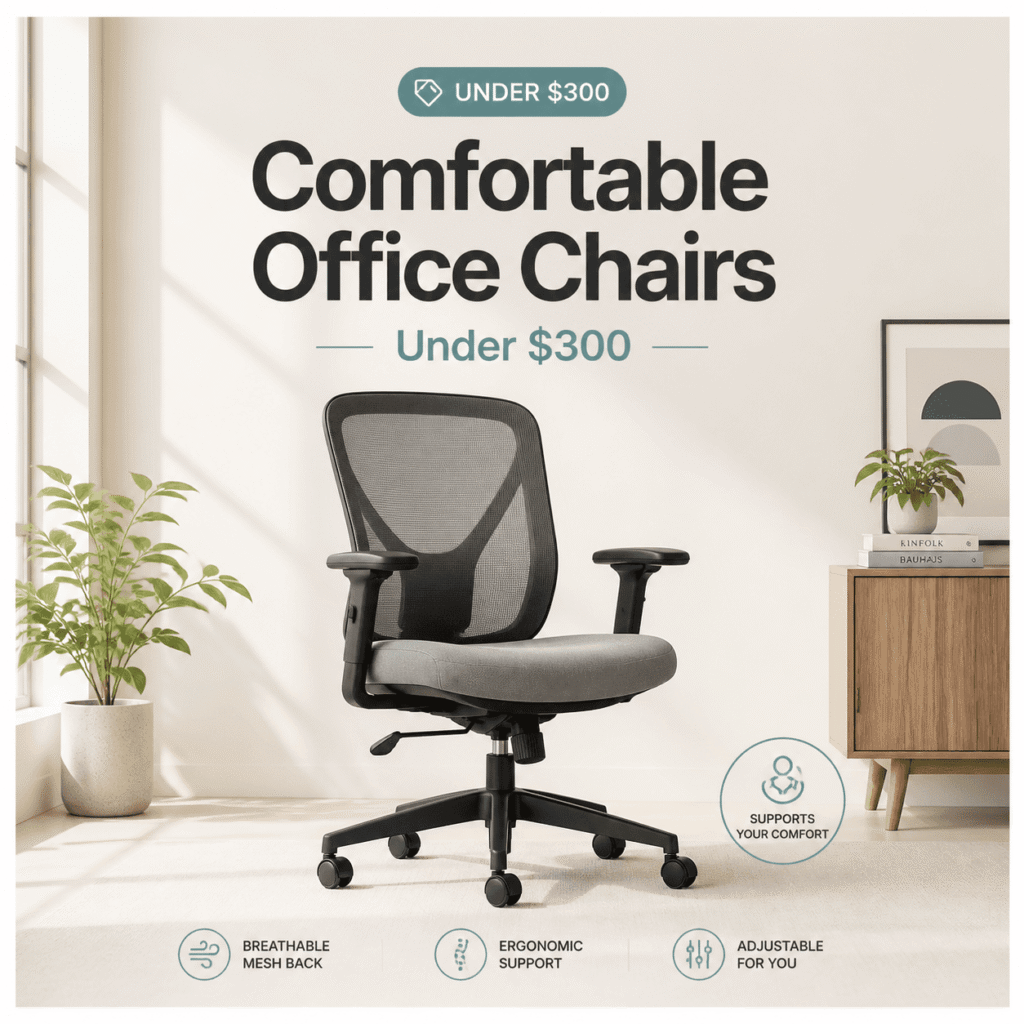
If you are searching for the best office chair under 300, bad lumbar alignment and bottomed-out seat cushions are likely causing unnecessary back pain during long work hours.
Buying an office chair used to be a straightforward task. You would walk into a store, try out a few chairs, select the one that felt “fine”, and move on.
However, with the shift towards longer working hours—whether at home, in a coworking space, or in a cramped spare room next to the laundry—the definition of “fine” changes. That seemingly acceptable chair transforms into a persistent problem as your lower back, neck, hips, and shoulders start to voice their discontent.
Moreover, chair marketing has taken a strange turn. The term “ergonomic” is thrown around liberally. Every chair claims to have “lumbar support”, yet many still resemble cafeteria seating after just 90 minutes of use.
This brings us to the purpose of this article – providing a practical list of office chairs under $300 that genuinely prioritize comfort. These are not miracle solutions or chairs that promise to permanently correct your posture. Instead, they are simply chairs designed for prolonged use without causing pain.
It’s important to note that comfort is subjective. Factors such as your height, weight, desk height, monitor position, and keyboard placement all play a significant role in determining what chair will work best for you. However, there are certain patterns and design choices that consistently appear in chairs that provide real comfort.
If you’re on the lookout for more workspace gear like this, you’re in luck! At Tool Pick Guide, we specialize in reviewing productivity tools and hardware from the perspective of someone who uses them extensively throughout the day—not just unboxing them for a thumbnail. We also curate lists like our essential gear for freelancers, which can significantly enhance your productivity.
Now, let’s dive into chairs.
What Makes the Best Office Chair Under 300 Actually Ergonomic?
The under $300 price range is where you can still find quality office chairs without expecting every premium feature available. It’s crucial to prioritize your needs during this selection process.
If you remember only a few key points from this guide, let them be these:
1) Seat comfort beats almost everything
Seat cushion quality and shape matters more than people think. Too firm and it feels like punishment. Too soft and you sink, your hips roll back, your lower back starts doing weird stuff.
Look for a seat that is:
- firm but not hard
- wide enough that your thighs are supported
- not aggressively sloped
- has a waterfall edge (the front edge curves down a bit so it doesn’t cut into your legs)
2) Adjustable lumbar is not optional
If the chair has “built in lumbar” that you cannot move, it might fit you perfectly. Or it might hit the wrong spot and feel like a knuckle in your spine.
Best case under $300 is lumbar you can adjust up and down, and ideally depth too. But even just height adjustable is a big win.
3) Armrests matter, but only if they’re adjustable
Fixed armrests can force your shoulders up or out. That turns into neck pain fast.
2D arms (up/down and in/out) are usually enough. 3D and 4D arms are nice but not required if the rest of the chair is solid.
4) Headrests are optional, don’t overpay for them
A headrest can be great if you recline a lot or do calls leaning back. But a bad headrest is worse than none. Under $300, headrests can be hit or miss.
5) Mesh backs can be amazing, until they aren’t
A good mesh back keeps you cool and supports you evenly. A bad mesh back feels like a trampoline or sags after a year.
Quick picks (if you don’t want to read the whole thing)
If you just want the short list, here’s the cheat sheet:
- Best overall comfort under $300: SIHOO M57
- Best budget ergonomic chair (often under $200): Ticova Ergonomic Office Chair
- Best for bigger builds / wide seat feel: Colamy Atlas (or similar Colamy mid back high back options depending on price that week)
- Best for a more “traditional” cushioned feel: Serta Smart Layers / Serta Executive style chairs (watch height and arm fit)
- Best Staples in store option: Staples Hyken or Dexley (depending on your height and seat width needs)
- Best IKEA option if you can test in person: IKEA MARKUS (simple, sturdy, a little polarizing)
Now the details, because details are where back pain lives.
1. SIHOO M57 (usually $200 to $300)
This one shows up constantly in “best chair under $300” lists, and honestly. There’s a reason.
The SIHOO M57 has that modern ergonomic shape that makes sense the second you sit in it. Mesh back, adjustable lumbar, decent recline, and it usually doesn’t do anything offensively wrong.
What it’s good at
- lumbar support that is actually supportive, not just decorative
- breathable back that doesn’t feel scratchy
- seat is firm enough for long sessions
- tilt feels stable, not like you are going to tip backwards
What to watch
- armrests can feel a bit basic, and some people wish they went lower
- seat depth is not super adjustable (depends on the exact variant and year)
- if you are very tall, you might wish the back was a little higher
Who should buy it
If you want the “safe pick” ergonomic chair under $300 and you do not want to overthink it. Freelancers, agency folks, remote workers. It’s one of those chairs that disappears once you set it up, which is kind of the goal.
2. Ticova Ergonomic Office Chair (often $150 to $250)
This is the budget chair that surprises people. You see the price and assume it’s going to be flimsy. Then you sit down and go, wait, this is… actually supportive?
The Ticova Ergonomic chair is popular for a reason: you get an adjustable headrest, adjustable lumbar, and generally good adjustability for the money.
What it’s good at
- strong feature set for the price
- lumbar you can move and tweak
- headrest included (and not totally useless)
- arms usually have more adjustment than you expect at this price
What to watch
- seat cushion can feel a little firm for some people, especially if you like plush seats
- long term durability is not going to match premium chairs, obviously
- some builds have a slight wobble if you do not tighten everything properly
Who should buy it
If you want maximum ergonomics per dollar. If you are setting up multiple workstations for a small team, this is one of the better “buy 3 or 4 of these and call it done” options.
3. Staples Hyken (often $150 to $250)
The Hyken is the chair you can actually try in person at Staples, which is a bigger deal than it sounds. Chairs are physical. Your body knows in 30 seconds what a spec sheet cannot tell you.
It’s a mesh chair with a headrest, decent lumbar curve, and a shape that works well for a lot of average height users.
What it’s good at
- breathable and supportive for the money
- easy to find, easy to return
- headrest included
- pretty good recline feel
What to watch
- seat is not super wide
- the mesh seat can feel tight if you prefer cushion
- if you are taller, the headrest might land weirdly (or feel low)
Who should buy it
If you are around average height, want mesh, and want something you can test quickly and return easily if it does not fit. Also good if you need a chair today, not next week.
4. Staples Dexley (often $180 to $300)
The Dexley is like the Hyken’s bigger sibling. Similar vibe, but generally a wider seat and a roomier feel.
If you sat in the Hyken and thought “almost, but I feel squeezed”, the Dexley is the next thing to try.
What it’s good at
- roomier seat and frame
- breathable mesh back
- solid “big box store” ergonomics without the weird Amazon gamble
What to watch
- mesh seat is still mesh, so if you want cushion, this might not be your thing
- not as adjustable as some Amazon ergo chairs on paper
- sometimes squeaks develop over time (varies)
Who should buy it
People who like mesh but want more space. Also, anyone who wants a chair they can physically try before buying.
5. IKEA MARKUS (usually $199 to $279)
The MARKUS is kind of hilarious because it’s been around forever, it looks simple, and people either love it or bounce off it immediately.
It’s a high back chair, has a tall backrest, and a more “lean back and work” posture. The lumbar is not super adjustable, but the overall shape works for a lot of bodies.
What it’s good at
- sturdy feel for the price
- tall backrest is genuinely nice if you are taller
- clean, simple, no fuss
- often easy to buy locally, and returns are straightforward
What to watch
- lumbar is not very adjustable
- armrests (on some versions) can be annoyingly positioned
- if the curve does not match your back, you will know fast
Who should buy it
If you want a simple, reliable chair and you can test it in an IKEA first. I really recommend testing this one. It’s a “fit” chair.
6. Branch Ergonomic Chair (sometimes around $299, sales vary)
Branch rides the line between “budget chair” and “entry level premium”. The Branch Ergonomic Chair is often right at that $300 line, sometimes slightly above unless there’s a sale.
But when it lands under $300, it’s a strong option. Clean design, solid adjustments, and it tends to feel more refined than the random Amazon brands.
What it’s good at
- balanced comfort, nothing too aggressive
- good adjustability where it counts
- looks like it belongs in a modern office, if you care about that
- support feels intentional, not accidental
What to watch
- price can drift above $300 depending on shipping and promos
- not the plushest seat if you want soft cushion
- armrests are okay, not legendary
Who should buy it
If you want something that feels more “professional” and consistent, and you can snag it at or under $300. Great for client facing home offices too.
7. Union and Scale (Target) and similar retail lines (often $200 to $300)
This is less about one exact model and more about a category. Target’s Union and Scale chairs can be surprisingly decent, especially if you choose a model with adjustable arms and decent lumbar shaping.
The advantage here is again. Easy returns. Easy pickup. No complicated shipping.
What it’s good at
- you can often try it or at least return locally
- some models have a more cushioned seat than mesh chairs
- good for “I need it this weekend” situations
If you’re considering an ergonomic chair from this category, it’s worth exploring how to choose the right one by understanding ergonomics.
What to watch
- lots of variation between models, and specs are not always clear
- some are style first, ergonomics second
- armrests are often the weak point
Who should buy it
If you want an in store buy and you don’t want to deal with shipping a chair back in a giant box. Just be picky about adjustability.
8. Serta Smart Layers / Serta Executive style chairs (often $200 to $300)
If you hate mesh seats and you want cushion, like actual cushion, Serta’s office chairs are worth a look.
They are not “ergonomic chair nerd” chairs. They are more like. Comfy, cushioned, traditional office chair. And for some bodies, that’s exactly what stops the pain. Especially if you feel pressure points on mesh.
What it’s good at
- plush seat and back feel
- good for people who want soft support
- often widely available
What to watch
- they can run hot
- armrests are sometimes too high or too fixed
- some models are bulky and sit high, which can be a problem if you are shorter or your desk is high
- lumbar support is usually not very adjustable
Who should buy it
If you prioritize cushion comfort and you do not need a million ergonomic adjustments. Also good if you sit upright and type a lot and mesh just does not work for you.
9. Colamy (Atlas and similar models) (often $200 to $300)
Colamy has a bunch of chairs in this price range, and the reason I’m including them is simple. Some of their models have a wider, flatter seat that works well if you hate that “narrow ergonomic bucket” feeling.
The exact model availability changes a lot, but the category is consistent: modern ergonomic-ish, with a more generous seat.
What it’s good at
- often a wider seat feel
- generally supportive back
- good value if you catch a well built model on sale
What to watch
- model naming is confusing, and quality varies by model
- sometimes the recline tension range is limited
- assembly quality matters, tighten everything
Who should buy it
If you are broader, or just want more room to move without the chair forcing you into one posture all day.
A mini comparison matrix (fast and useful)
| Chair | Best for | Seat feel | Back style | Return ease |
| SIHOO M57 | Balanced ergonomic comfort | Medium firm | Mesh | Medium |
| Ticova Ergonomic | Feature value | Firm | Mesh | Medium |
| Staples Hyken | Try in store, average builds | Mesh seat | Mesh | High |
| Staples Dexley | Wider mesh option | Mesh seat | Mesh | High |
| IKEA MARKUS | Simple, tall back | Medium | Cushioned back | High |
| Branch Ergonomic | Refined “entry premium” | Medium | Mesh | Medium |
| Serta (various) | Plush cushion comfort | Soft to medium | Cushioned | High |
| Colamy (various) | Roomier seat options | Medium | Mesh or hybrid | Medium |
Not scientific, just real life buying clarity.
How to set up your chair so it doesn’t hurt (even a good chair can fail here)
This is the part people skip. They spend $250, sit down, still hurt, and assume the chair is bad.
Sometimes it is. But often the setup is off.
Step 1: Seat height
Sit down and set your height so:
- feet are flat on the floor
- knees around 90 degrees, maybe slightly more open than 90
If your desk is high and you raise the chair, you might need a footrest. A cheap footrest can fix what a better chair cannot.
Step 2: Seat depth
You want about 2 to 3 fingers of space between the front of the seat and the back of your knees.
If the seat is too deep, it cuts circulation and makes you slide forward. Then you lose back support. Then pain shows up.
Step 3: Lumbar position
The lumbar support should hit the curve of your lower back. Not your mid back. Not your tailbone.
If the lumbar is too strong, back off. People think more lumbar is always better. It’s not. Too much forces you forward and you start compensating with your neck.
Step 4: Armrest height
Set armrests so your shoulders stay relaxed. If your shoulders creep up, lower the arms.
If armrests are too wide, your elbows flare out and your upper back gets tight. In/out adjustment helps a lot here.
Step 5: Recline is not a sin
A tiny recline often feels better than rigid upright posture. Especially for long writing sessions or calls.
If your chair reclines and locks, try a slight recline and see if your lower back relaxes. This is one of those “small change, big effect” things.
What I would personally do with $300 (two scenarios)
Scenario A: You want the safest ergonomic pick
I would start with SIHOO M57 or Branch Ergonomic Chair if it’s on promo under $300. Then I’d spend the leftover on:
- a basic footrest if needed
- monitor riser if you are looking down all day
A chair alone cannot fix a monitor that is 6 inches too low.
Scenario B: You want the easiest return and zero hassle
I’d go to Staples and sit in the Hyken and Dexley back to back. Pick the one that fits. Done.
This sounds boring, but boring is good when you are buying something you will sit on for 2,000 hours a year.
A couple of chairs I would avoid (even if the reviews look good)
I’m not going to name and shame every random listing, but here are common red flags in this price range:
- “Gaming chair” style with thick side bolsters. They lock you in, push shoulders forward, and look comfy until your back hates you.
- Chairs with a super thick pillow seat but no real lumbar. Feels good for 20 minutes, then you slump.
- Anything with thousands of reviews but no clear brand identity and seven identical listings with different names. That return process can be painful.
Wrap up (and what to do next)
If you are trying to buy an office chair under $300 that does not hurt, you are not being picky. You are being normal. Sitting pain is expensive in a slow way. Less focus. More breaks. Weird stiffness at night. It adds up.
If you want the simplest answer:
- SIHOO M57 is the best all around bet.
- Ticova is the best value ergonomic feature stack.
- Staples Hyken or Dexley are the best “go sit in it today” options.
- IKEA MARKUS is the best simple chair if it fits your back.
- Serta is worth it if you want plush cushion comfort, not mesh.
And if you’re building out a whole workspace and want more no nonsense comparisons, that’s what we publish at Tool Pick Guide. Software, workflows, hardware, the stuff you actually use every day. You can treat it like your shortcut before you buy the wrong thing and spend a month annoyed.
That’s it. Buy the chair. Tighten the bolts. Set the lumbar correctly. And please, raise your monitor.
FAQs (Frequently Asked Questions)
What should I prioritize when buying an office chair under $300?
When choosing an office chair under $300, prioritize seat comfort, adjustable lumbar support, and adjustable armrests. The seat should be firm but not hard, wide enough to support your thighs, and have a waterfall edge to prevent leg discomfort. Adjustable lumbar support is essential for proper back alignment, and armrests should ideally be adjustable in height and width to prevent shoulder strain.
Why is adjustable lumbar support important in an office chair?
Adjustable lumbar support is crucial because a fixed lumbar can either perfectly fit or painfully press against the wrong spot on your spine. Being able to adjust the lumbar height and depth ensures that the chair supports your lower back properly during prolonged use, reducing discomfort and potential pain.
Are headrests necessary in office chairs under $300?
Headrests are optional in office chairs under $300. They can be beneficial if you frequently recline or take calls while leaning back. However, a poorly designed headrest can cause more discomfort than having none at all. Given the price range, headrests can be hit or miss, so it’s better not to overpay for this feature unless you specifically need it.
What are some recommended office chairs under $300 for comfort?
Some top picks for comfortable office chairs under $300 include: SIHOO M57 (best overall comfort), Ticova Ergonomic Office Chair (best budget ergonomic option), Colamy Atlas (best for bigger builds with a wide seat), Serta Smart Layers or Executive style chairs (for traditional cushioned feel), Staples Hyken or Dexley (store staples depending on fit), and IKEA MARKUS (simple and sturdy if you can test it in person).
How does seat cushion quality affect office chair comfort?
Seat cushion quality significantly impacts comfort during long hours of sitting. A seat that’s too firm feels punishing, while one that’s too soft causes sinking, hip rolling backward, and lower back strain. The ideal seat is firm yet comfortable, supports your thighs well without aggressive slopes, and features a waterfall edge to reduce pressure on the legs.
What role do armrests play in preventing neck and shoulder pain?
Armrests help maintain proper shoulder positioning by supporting your arms. Fixed armrests can force your shoulders upward or outward, leading to neck pain over time. Adjustable armrests with up/down and in/out movements (2D adjustment) are usually sufficient to ensure ergonomic positioning and reduce strain on your neck and shoulders.